Mirissa, Sri Lanka: Whale Watching and South Coast Beaches
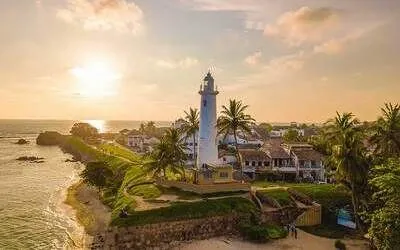
A curved bay of golden sand backed by coconut palms, Mirissa is the south coast’s best-known base for whale watching, with warm water for swimming, a laid-back beach-town pace and Galle Fort close enough for an easy half-day trip.
A small beach town built around its bay
Mirissa began as a quiet fishing village on Sri Lanka’s south coast and has grown, without ever quite losing that feel, into the region’s best-known base for whale watching and beach time. The town itself is small enough to cross on foot in twenty minutes, with the main crescent bay backed by palms, a scatter of open-air restaurants and guesthouses stacked up the low hillside behind it. At the harbour on the western end, wooden fishing boats still land the morning catch, and from around November the same stretch of water fills with whale watching boats heading out before dawn. It is a working coastal town first, a resort second, which is part of why it still feels relaxed even in the busiest months.
Whale watching, roughly November to April
Mirissa is Sri Lanka’s main whale watching port, and one of relatively few places worldwide where blue whales are seen with any regularity, alongside sperm whales, spinner dolphins and, less predictably, orcas. The season runs roughly from November to April, when the south-west monsoon eases and the sea calms enough for boats to head further offshore; December to March is generally considered the most reliable stretch. Boats typically leave the harbour around 6–6:30am for a three-to-four-hour trip, so an early wake-up is part of the experience. Sightings are never guaranteed on any single trip, and we favour operators who keep a respectful distance from the animals and limit boat numbers rather than chasing every pod.
Mirissa’s beaches and Coconut Tree Hill
The main beach is a sheltered crescent bay, calm enough for swimming on most days outside the monsoon and lined with sunbeds, beach bars and simple seafood restaurants that fill up around sunset. At its eastern tip, Parrot Rock is reachable on foot across a rocky causeway at low tide and makes a good sunset viewpoint over the bay. A short walk or tuk-tuk ride inland, Coconut Tree Hill (also called the Mirissa viewpoint) is a headland planted with leaning coconut palms above the ocean — one of the most photographed spots on the south coast, and best visited early morning or late afternoon when both the light and the crowds are easier.
Beyond the beach: surfing, snorkelling and sunset walks
Weligama, ten to fifteen minutes along the coast road, has some of Sri Lanka’s most reliable beginner surf breaks and several surf schools offering lessons and board rental, an easy add-on to a Mirissa stay without changing hotels. Snorkelling around the rockier points near Mirissa and Weligama can turn up reef fish and the odd turtle, best in calm, clear conditions. Evenings tend to centre on the beach bars and a scatter of night-market-style food stalls along the main road, low-key rather than a party scene compared with some other south-coast towns, which suits travellers looking to slow down after a few days of touring inland.
Practical tips for visiting Mirissa
Swimming conditions are generally calm inside the main bay, but currents and undertow can strengthen quickly, especially towards the shoulder months around the monsoon change — some sections are better supervised than others, so ask locally before swimming off the beaten path. Choose a whale watching operator carefully: smaller boats, a stated limit on numbers near whales and a realistic attitude toward sightings are better signs than a guaranteed encounter. Rooms with a sea view or easy beach access book out well ahead in the December-to-March peak, so reserving early matters more here than in many inland destinations. Sun protection is worth taking seriously — the beach offers little natural shade in the middle of the day.
Weather in Mirissa
Like the rest of Sri Lanka’s south-west coast, Mirissa sits in the wetter of the island’s two monsoon zones, with the main monsoon roughly May to September bringing heavier rain, rougher seas and an unreliable whale watching season. December to March is the driest, sunniest window and by far the most popular time to visit, for beach days and boat trips alike. October, November and April sit in between and can bring a mix of clear days and short, heavy showers; whale watching sometimes starts a little early or runs a little late depending on how the season develops, so it is worth checking current conditions closer to your travel dates.
Nearby: Galle Fort, Weligama and beyond
Galle Fort is roughly 25–40 minutes away by road, close enough to combine a whale watching morning with an afternoon inside the old Dutch ramparts, or the reverse, without an early alarm on both ends. Weligama, just ten to fifteen minutes away, adds surfing and a look at the region’s famous stilt fishermen to the same stretch of coast. Further afield, Yala National Park is a longer transfer of around two-and-a-half to three hours, usually built into multi-day south-coast itineraries rather than a day trip, while Matara, a larger working town just past Mirissa, makes a practical stop for banks, shops or onward transport.
Visiting Mirissa with Sundown Tours
A whale watching morning means an early start, and that is exactly the kind of logistics a private driver takes off your hands: pickup from your hotel while it is still dark, waiting at the harbour through the trip, and a flexible plan for the rest of the day once you are back on dry land. Whether that means a nap, a slow beach afternoon or straight on to Galle Fort is entirely up to you. We build Mirissa into south-coast routes alongside Galle, Weligama and Yala, timed around the whale watching season where it fits your dates, with hotel pickups and each transfer arranged in advance so the only early alarm you have to think about is the one for the boat.
Add Mirissa to your south coast itinerary
Our private tours pair a Mirissa whale watching morning with Galle Fort, Weligama’s surf breaks and the wider south coast, with your chauffeur handling the early start to the harbour and every transfer in between.
Plan your Mirissa visitWhatsAppHighly Rated Tours
Related destinations
Related guides
Where to eat
Frequently Asked Questions
When is the best time for whale watching in Mirissa?
Roughly November to April, with December to March generally the calmest and most reliable stretch of the season. Outside these months, boats may not run at all if the sea is too rough.
Is Mirissa a good beach for swimming?
The main bay is generally calm and suitable for swimming outside the monsoon months, though currents can pick up in places. It is worth asking locally about conditions on a given day rather than assuming every stretch of beach is equally safe.
How far is Mirissa from Galle Fort?
About 25 to 40 minutes by road, depending on traffic, which makes a whale watching morning followed by a Galle Fort afternoon (or the reverse) an easy combination on a private itinerary.
Can I combine Mirissa with surfing at Weligama?
Yes. Weligama is only ten to fifteen minutes away and has some of the country’s most reliable beginner surf breaks, so a morning lesson there fits easily around a Mirissa-based stay.
How many nights should I spend in Mirissa?
One or two nights is enough to fit in a whale watching morning and some beach time; travellers who enjoy the slower beach-town pace, or who want a buffer day in case a boat trip is cancelled for weather, often stay a little longer.